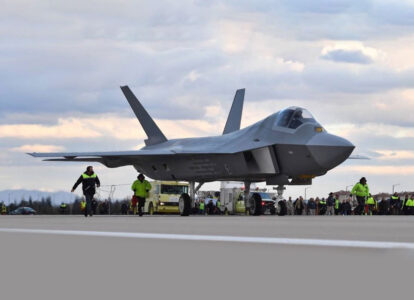
Turkish Aerospace (TAI) unveiled its Milli Muharip Uçak (MMU, National Combat Aircraft) fifth-generation fighter formerly known as the TF-X on the occasion of Turkey’s Victory Day (March 18), which honors the Battle of Anakkale (Gallipoli), that fell on the same day as the 100th anniversary of Kemal Atatürk’s creation of the modern Turkish Republic.
The aircraft performed a self-propelled taxi before a low-key launch ceremony two days later.
The MMU prototype closely mimics the mock-up displayed at international air shows, albeit with a more “humped” profile that gives the pilot a better overall view but makes TAI’s goals for supercruising more difficult. This aircraft, which resembles the F-22/F-35 in some ways, is meant to combine low-observable (LO) design elements, such as the utilization of internal weapons bays, leading-edge alignment, and most likely radar-absorbent materials and structures. In addition to having infrared search and track and electro-optic arrays above and below the nose in LO deployments, TAI claims the aircraft possesses an AESA radar with “more than twice as many [transmit and receive modules]” as the F-22’s AN/APG-77.
The MMU is one of three Block 0 development aircraft that make up Phase One of the program. The final aircraft will be completed in 2026 and will each be powered by two General Electric F110 engines. Although the maiden flight was originally scheduled for 2026, TAI now anticipates it will occur by the end of this year. The Turkish Air Force will receive 10 Block One aircraft as part of Phase Two, which will start in late 2028 and last until 2033. Deliveries of follow-on Blocks will commence off Phase Three in 2034.
The fifth-generation MMU was initially planned to complement the high-end F-35 as the less capable part of a high/low mix of fighter aircraft types. The MMU has gained additional significance as a result of Turkey’s withdrawal from the F-35 program, at least initially serving as the future force’s high-end component alongside modernized F-16s. After then, the first-generation MMU might help the MMU eventually satisfy the high-end need.