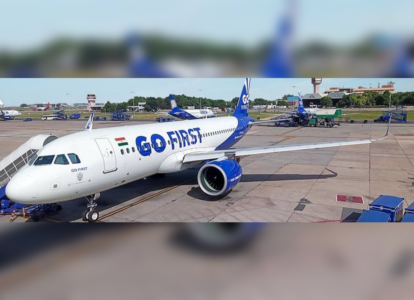
Go First (G8, Mumbai International) has filed for bankruptcy, and the resolution specialist managing the case has requested expressions of interest (EOI) to purchase the airline. Shailendra Ajmera of Ernst & Young’s New Delhi office has started the first of several processes to sell the airline that are required by Indian insolvency law, according to an advertising published in business media in India on July 10.
The commercial provides little details, stating only that Go First employs over 4,200 people, has assets spread across several airports in India, and generated INR41.83 billion (USD506.2 million) in revenue in the year ending March 31, 2022. The deadline for EOIs is August 9, 2023, and a short list of selected candidates will be announced on August 19.
Go First suspended services in early May, filing for voluntary administration soon after, with the airline owing creditors approximately INR65 billion (USD786.6 million). In the 2021/22 fiscal year, Go First recorded a loss of INR10.08 billion (USD218.8 million) on revenues of INR41.84 billion (USD506.3 million) and had a negative net worth of INR32.22 billion (USD 390 million).
Notably, almost all of Go First’s 54 aircraft are leased, with several lessors agitating for the return of their planes. Data from the ch-aviation fleets advanced module shows at least 52 of the 54 planes are leased from 12 different lessors. India’s National Company Law Tribunal (NCLT) has stopped lessors from retrieving their aircraft. An appeal by aircraft owners to the appellate tribunal was unsuccessful, although India’s High Court granted certain of them access to their aircraft for maintenance and inspection purposes last week. Since then, Ajmera, on behalf of Go First, has filed an appeal to that High Court order.
Separately, the Singapore International Arbitration Centre (SIAC) made another interim ruling late last week, ordering Pratt & Whitney to supply Go First with five engines every month between August 1 and December 31, saying, “the respondent (Pratt & Whitney) must take all reasonable steps to release and dispatch to the claimant (Go First), without delay as they become available.”
Go First blamed crippling Pratt & Whitney PW1000G engine supply issues when filing for insolvency. In April, approximately 50% of Go First’s aircraft were grounded because of engine issues, growing from around 30% in late-2020. Go First maintains that the engine issues have cost it INR108 billion (USD1.3 billion) and have sued the engine manufacturer. The airline reportedly has dozens of Pratt & Whitney powerplants waiting for servicing at MRO facilities around India, dozens more defunct engines waiting to be retrieved, and expects another six engines to go out of service between now and November.
Go First began arbitration in Singapore earlier this year, seeking to have Pratt & Whitney abide by its contractual obligations. In a media statement released after last week’s ruling, Pratt & Whitney said it would comply with the arbitration’s ruling. However, it has previously challenged interim rulings, citing global supply chain issues and Go First’s history of missed payments. The SIAC is due to hand down its final judgment later this month, and it is expected to be a decisive factor regarding the airline’s future viability and sale prospects.