Even though social upheaval has caused aircraft delays and cancellations across the continent in recent weeks and labor groups have declared further strikes, European airline Executives anticipate less operational problems this summer than they did in the summer of 2022. A strike by the easyJet cabin crew union in Portugal is scheduled for April 1–3, a pilots’ strike by TAP Air Portugal has been threatened for April 7–10, and workers at Heathrow Airport Terminal 5 who screen passengers and cargo have scheduled a strike for March 31–April 9. Additionally, in opposition to the French pension reforms, air traffic controllers in France have announced additional work stoppages.
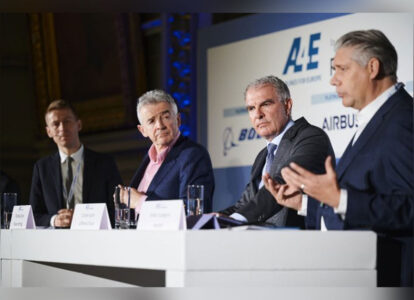
In the remarks by Ryanair Group CEO Michael O’Leary at the Airlines for Europe (A4E) summit on Wednesday in Brussels, said: “The summer [of 2023] will be much better in Europe than it was last year, but that does not imply it will be easy.” He expects “materially worse” air traffic control disruption than airlines experienced last year due to restrictions in European airspace caused by Russia’s invasion of Ukraine and strikes by air traffic controllers, primarily in France. This is despite the fact that airports have done “a tremendous” job at re-staffing. In the first three months of 2022, French controllers announced three days of strikes, while in the first three months of this year, 23 days.
Demand is still robust, and passenger numbers may surpass 2019 levels, according to Luis Gallego, the new A4E chairman and CEO of International Airlines Group. While stating that air traffic controller stoppages are “far from ideal as we approach into one of the busiest summers in preceding years,” he anticipates operations to be more dependable than they were last year. He asked everyone involved in the air transportation chain to assume responsibility in order to prevent the pandemonium of last summer and desist from enforcing impromptu capacity restrictions.
Separately, Lufthansa Group CEO Carsten Spohr forecasts strong passenger demand in summer 2023. In terms of operational efficiency, however, “it will be better than last year but not good,” he said, amid staff shortages at some airport service providers and ATC bottlenecks. Twenty percent of European airspace is closed because of the events in Ukraine and a big NATO maneuver will take place in parts of European air space in June, he pointed out. “It will be the worst summer in terms of flight delays,” remarked Spohr.
Spohr’s assessment aligns with the conclusion of a draft report by the Eurocontrol Performance Review Commission (PRC), released on March 27. “Without a doubt, 2023 will also be a challenging year for European aviation, stated Eurocontrol PRC chair Marinus de Jong.
“It will require a massive effort of all stakeholders to avoid a repetition of the unacceptable situation of summer 2022, when almost every second flight was delayed, and numerous cancellations left frustrated passengers stranded at airports.”
The AE4 organization, whose members in 2022 operated more than 3,300 aircraft and transported more than 610 million passengers, reiterated on Wednesday its long-standing demands for the EU261 air passenger rights regulation to be changed so that airlines could charge those who caused disruptions, such as air traffic control, for their costs. “Almost ten years ago, the European Commission first suggested reforming EU261. Nothing has occurred, said O’Leary.