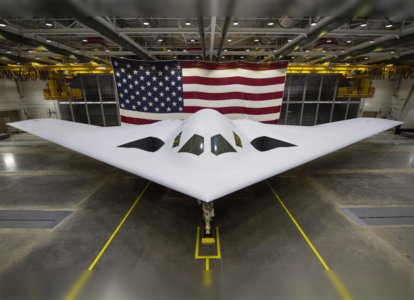
The two distinctive air inlets of the Northrop Grumman B-21 may be seen for the first time in clarity in a recently published photo of the bomber.
The U.S. Air Force revealed the image on March 7 and it shows, for the first time, that the inlets resemble sideways teardrops.
The boundary layer of air passing over the leading edge of the wing appears to have been ingested by a bulbous inboard part that the designers placed in that location.
The inlet similarly seems to be L-shaped when seen from above, with a right angle located at around one-third of the inlet’s length. The outboard part is approximately two thirds of the length and sweeps forward from both sides at a right angle.
The B-21 also features two indentations on either side of the aft fuselage, above the engine nacelles. Slits for additional inlets or exhausts could be present in the openings. They could also serve as sensor or communication apertures.
On the wings and fuselage, a number of stenciled marks may be seen. As seen from the cockpit, the advanced projects branch of Northrop is represented by a sign on the right wing. On the left wing, the US Air Force’s roundel is visible. Three more unit insignia may be seen along the right side of the fuselage beyond the cockpit, but the details are obscured.
The Air Force chief of staff, Gen. C.Q. Brown, used the image in a speech at the Aurora, Colorado, Warfare Symposium.
The B-21 was first unveiled by the Air Force on December 2 during a ceremony at the Northrop facility in Palmdale, California, although views of the inlet were purposefully hidden from the crowd and live television. The bomber’s aft part has never been made public, and neither have the bomber’s number and identify of engines been revealed.
The B-21 is still scheduled to fly this year, but Air Force officials do not offer more details. “It will fly when it’s ready,” Andrew Hunter, the assistant secretary of the Air Force for acquisition, technology and logistics, told the symposium audience on March 7.
According to Gen. Thomas Bussiere, the head of Global Strike Command, the B-21’s mission system recently proved in simulations that it was capable of detecting, locating, tracking, and destroying a target. Bussiere’s comments raise the possibility that the B-21 is further along than the Lockheed Martin F-22 and F-35 at the same level of development, despite the fact that no additional information was provided.
“The capabilities and technology integrated into that weapon system is second to none,” Bussiere said. “It will be the most advanced strike platform ever designed or built on the planet.”